

To compare ready-made emergency kits online in 2026, put each seller’s packing list into the same worksheet: household size, supplied quantities, usable functions and additions you still need. Choose the kit that fits your household and apartment—not the one with the longest equipment list—and keep stored water, food and personal supplies separate from the backpack’s contents.
- Compare ready made emergency kits online using equal household sizes, quantities and functions—not item counts.
- ReadySet emergency kits are an option for households seeking a prepared starting point, not a substitute for checking supplies.
- Separate supplied drinking water from water-treatment equipment, and supplied food from your household’s full reserve.
- For an apartment, check storage access, carrying arrangements and how equipment works without mains power.
Why this matters
An emergency kit has two different jobs to consider: helping you manage disruption at home and giving you something manageable to take if you leave. Those jobs overlap. They are not identical.
A large water reserve belongs in your household plan, but carrying all of it downstairs is a different decision. Likewise, a compact backpack can be easy to store without containing enough food and drinking water for everyone. If you also need a family-specific decision, keep the family emergency-kit guide separate from this comparison worksheet.
For your 2026 shortlist, compare what each offer actually supplies against the same household needs. Treat product names and broad promises as an introduction, not as the packing list.
How do you compare ready-made emergency kits online?
Use the following sequence for every seller. Keep the product page and instructions together so you can check what a description means before adding it to your worksheet.
- Set your household size. Record adults, children and anyone with individual requirements. Do not compare a single-adult kit directly with a family kit.
- Choose the main use. Decide whether you need supplies for staying home, an evacuation bag or a combination with separately stored reserves.
- Copy actual quantities. Record drinking water in litres, food by pack weight and stated energy, and personal equipment by recipient.
- Check how each function works. Read instructions for lighting, charging, communication, food preparation and water treatment.
- List household additions. Include extra drinking water, suitable food, medication, documents and anything specific to your family.
- Check apartment access. Identify where supplies will sit, who can reach them and who can carry the bag if the lift is unavailable.
- Resolve unanswered questions. Ask for quantities, instructions or dimensions before choosing between otherwise similar offers.
Use this worksheet for your 2026 comparison. A blank field means you still have a question; it does not mean the item is included.
| Comparison field | What to record for each kit | What makes the comparison fair |
|---|---|---|
| Household size | Intended adults and children | Match the same household composition |
| Drinking water | Supplied volume in litres | Count stored potable water separately from treatment |
| Food | Pack weight, stated energy, ingredients and preparation | Compare equal quantities and usable food |
| Lighting | Type, power source and operating instructions | Compare the task the light must perform |
| Communication | Radio functions, charging and instructions | Separate receiving information from contacting someone |
| Personal supplies | What is supplied and what you add | Account for each household member |
| Storage | Packed dimensions and storage instructions | Check the space you actually have |
| Carrying | Packed weight and carrying arrangement | Include additions you intend to carry |
Keep the categories separate as you fill them in. A treatment tablet cannot fill the drinking-water row, and a power bank cannot automatically fill the household-backup-power row.
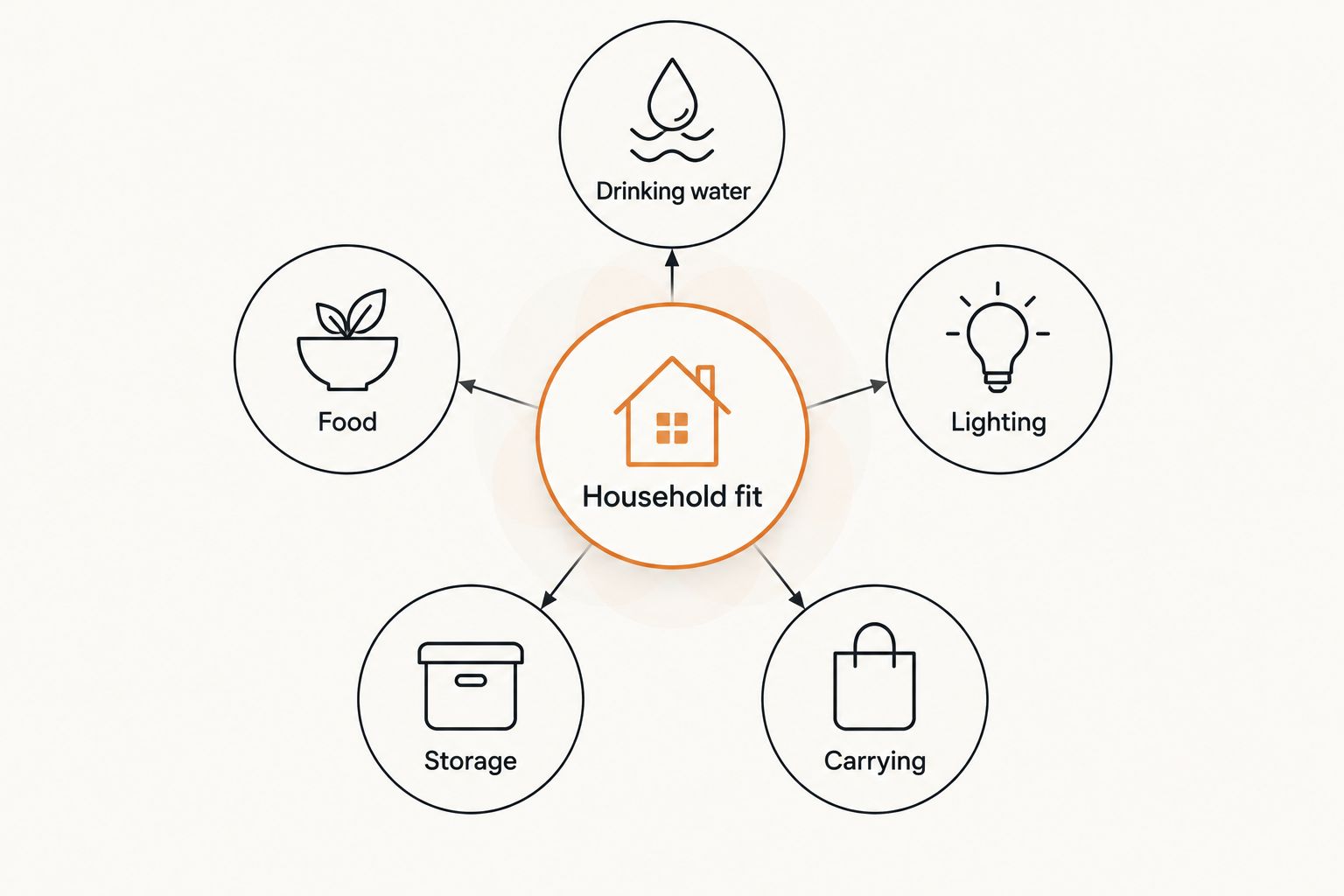
Compare the right type of setup
A ready-made kit, a self-assembled bag and a home reserve solve different parts of the same problem. Choose the arrangement first, then compare its contents. Otherwise, you risk rejecting a useful home reserve because it is not portable—or choosing a portable bag without checking what remains at home.
| Setup | Best for | Main advantage | Main limitation |
|---|---|---|---|
| Ready-made kit | Households wanting a prepared starting point | Groups equipment into one purchase | Still needs a contents check and personal additions |
| Self-assembled bag | Households with specific equipment or dietary needs | Lets you select each component | Requires you to check compatibility and omissions |
| Home reserve | Households preparing to remain in their apartment | Keeps supplies where they will be used | Is not automatically manageable for evacuation |
ReadySet emergency kits suit households wanting a prepared starting point. The limitation is straightforward: you still need to check the current packing list against your household’s water, food and personal requirements.
For example, ReadySet identifies its Duo kit for two adults and its Family kit for two adults and two children. Those are different household profiles; a family label does not establish suitability for four adults. Use those stated profiles as the start of your comparison, then inspect the quantities.
Is a ready-made emergency kit better than packing your own?
A ready-made emergency kit is better suited to you when you want grouped equipment and accept the supplied selection. Packing your own gives you more control, but neither route removes the need to check quantities, instructions and personal needs.
Does a bigger emergency kit give better protection?
A bigger emergency kit is not automatically a better fit. Extra equipment only helps if your household can use it, store it and carry whatever needs to leave the apartment.
Why emergency-kit suitability varies
The same kit can fit one apartment household and leave another with important gaps. These are the factors to compare—not reasons to buy more equipment without a purpose.
- Household composition: One adult, two adults, and two adults with children need separate comparisons.
- Food requirements: Ingredients, allergens and preparation instructions affect whether the supplied food is usable.
- Water arrangements: Stored drinking water and treatment equipment perform different functions.
- Access and mobility: Stairs, storage height and carrying responsibilities affect practical use.
- Existing supplies: Equipment you already have changes what you need to add.
- Individual needs: Medication, glasses, infant supplies and other personal items require their own checklist.
Write down these requirements before browsing. It is easier to reject an unsuitable offer when you already know what your household needs.
Separate the kit’s contents from household additions
Create three columns: Supplied, Add at home and Carry out. This prevents the contents of a photographed backpack from becoming your entire preparedness plan.
In the supplied column, copy only quantities explicitly listed for that kit. In the additions column, put the water, food and personal supplies needed beyond those contents. In the carrying column, identify what you would actually take and who would carry it.
Use units rather than vague descriptions. A 500 ml drinking-water pouch is a stated quantity of water; a 500 g food ration is a stated weight of food. Neither figure establishes how long your whole household is covered.
The supplied product description for the Seven Oceans ration lists 2,500 calories per 500 g pack. That is a pack total, not a daily allowance for every person in the household. Check how many packs the chosen kit actually contains before calculating any food total.
Similarly, water-treatment tablets are not stored drinking water. Their presence should never increase the litres recorded in your supplied-water column.
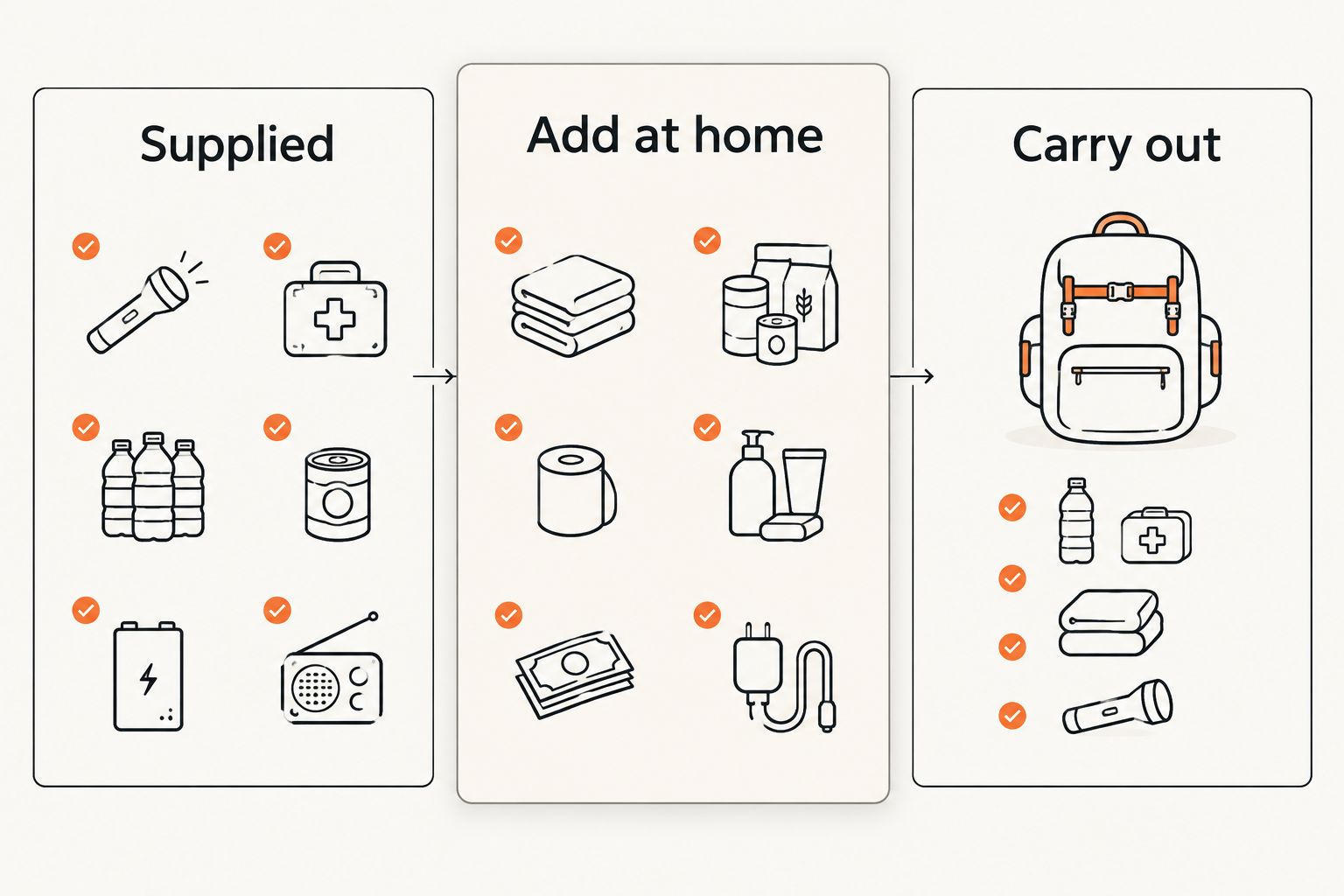
For your 2026 worksheet, record where each quantity came from: the current packing list, the packaging or the instructions. Save the date beside the information so an older screenshot does not quietly become your source for a later purchase.
Check functions, not just equipment names
A list saying “light, radio, power bank” leaves practical questions unanswered. Give every item a job. Then check whether the instructions support that job.
Lighting: nearby tasks or distance?
A light for reading instructions or finding supplies has a different job from one used to see farther down a route. When comparing specifications, flashlight throw distance and lumens describe different aspects of lighting; a headline brightness figure alone does not answer both questions.
Record the intended task beside each light. Check its controls, charging method and stated operating information rather than assuming two lights are interchangeable.
Communication: receiving information or staying in contact?
An emergency radio and a pair of walkie-talkies perform different roles. Do not treat them as equivalent entries simply because both appear under communication.
Check the radio’s stated reception functions and how it is powered. For walkie-talkies, read the operating instructions and decide who would use each handset. Avoid building your plan around an unverified range claim.
Charging: what will you connect?
List the devices you intend to charge and check their connectors and requirements against the supplied equipment. A power bank’s capacity figure is not a promise that it can run every household device.
Read solar and hand-crank charging instructions before counting on either method. Keep cables in the comparison too: a charging device without the connection you need does not complete the task.
Apply the apartment test before choosing
Your apartment determines where supplies fit and how easily you can reach them. Check the proposed storage place, not just the cupboard you hope to clear later.
Use this practical checklist:
- Can you reach the light without moving the whole kit?
- Can everyone who needs access open the bag or container?
- Does the chosen location follow the contents’ storage instructions?
- Can you keep supplies accessible without obstructing your exit?
- Who carries the bag if you leave by the stairs?
- Where will additional water and food go?
- Can you identify personal items without unpacking everything?
Separate shared equipment from personal necessities. A household can share some tools, while medication and glasses belong to the person who needs them.
Choose a carrying arrangement your household can manage. If someone has limited mobility, decide on assistance and accessible storage rather than assuming a larger backpack solves the problem.
Make the final decision from evidence
Before ordering, read your comparison from top to bottom. Each claimed function should have an item behind it, each quantity should have a source, and each household gap should have an addition beside it.
Keep the decision simple:
- Choose when the household profile fits, quantities are clear and the remaining additions are manageable.
- Ask first when an important quantity, instruction or carrying detail is unclear.
- Leave it off your shortlist when you cannot establish whether the supplied food, water arrangements or equipment fit your needs.
Do not give an unexplained omission the benefit of the doubt. Ask a precise question, such as how many drinking-water pouches are supplied, rather than asking whether the kit is “complete.”
FAQ
What is the best way to compare emergency kits online?
Compare emergency kits using the same household size, supplied quantities and required functions. Record water, food, equipment and personal additions separately so a longer item list does not distort the decision.
Is a ready-made emergency kit enough for an apartment?
A ready-made emergency kit is a starting point, not proof that an apartment household has sufficient supplies. Check its actual contents, then add the stored water, suitable food and personal items your household needs.
Does a kit for four people suit four adults?
A kit described for two adults and two children should not automatically be treated as a kit for four adults. Check the intended household profile and actual supplied quantities.
Do water-purification tablets count as drinking water?
Water-purification tablets do not count as stored drinking water. Record supplied potable water by volume and list treatment equipment separately.
Should I compare emergency kits by the number of items?
Compare emergency kits by usable functions and quantities, not item count alone. Several small pieces can increase the count without resolving a household need.
What should I ask a seller before buying an emergency kit?
Ask for the current packing list, supplied quantities, food information, operating instructions and packed dimensions or weight. Focus on details that affect your household’s ability to use and store the kit.
How do I compare food in different emergency kits?
Compare the number of packs, pack weight, stated energy, ingredients and preparation instructions. A pack’s total energy does not establish full nutrition coverage for every household member over the kit’s advertised duration.
One last thing
Before you finish your 2026 comparison, add one final line: What must happen before this kit is usable in our home? The answer might be charging a device, adding medication, finding accessible storage or buying more drinking water.
That line turns a product comparison into a practical plan. Choose the option whose remaining work you understand—not the one whose description makes you forget to ask.


